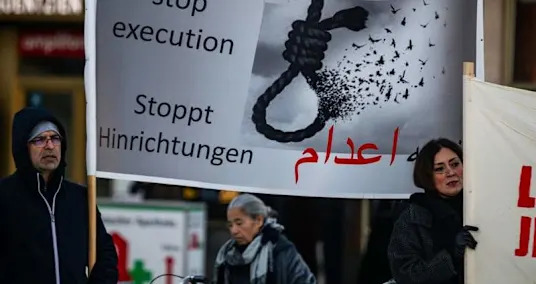
Two of those executed on Monday were killed without advance notice, denying them the chance to meet with their lawyers or say goodbye to their families, according to Amnesty International.
Iran executed two men tied to the People’s Mojahedin Organisation of Iran (PMOI), adding to two other men who were executed on Monday, the group said on Tuesday, confirming a report by Iran’s judiciary news outlet.
PMOI members, 34-year-old law school graduate Babak Alipour and 33-year-old electrical engineer Pouya Ghobadi, were killed on Monday after being convicted of links to the outlawed group and for alleged involvement in multiple attacks, including firing launcher weapons at a government building, according to the judiciary outlet.
Akbar Daneshvarkar, 60, and Mohammad Taghavi-Sangdehi, 59, were also hanged on Monday for alleged membership in Mujahideen-e-Khalq.
Daneshvarkar and Sangdehi were killed without advance notice, denying them the chance to meet with their lawyers or say goodbye to their families, according to Amnesty International.

Abolhassan Montazer and Vahid Bani Amerian, who were tried in the same case, are at imminent risk of death, and communication with the men has so far been impossible to establish, the NGO warned, adding that sources indicated all were subjected to torture during their detention.
“They were chivalrous men who did not bow to any torture or pressure and stood firm on their pledge and covenant until the very end,” Maryam Rajavi, president-elect of the Paris-based National Council of Resistance of Iran (NCRI), the political arm of the PMOI, said in a statement confirming the executions.
She said a number of PMOI members and other political prisoners remained on death row and called for international action to be taken to save their lives.
People’s Mojahedin Organisation banned in Iran
The NCRI, also known as PMOI, is banned in Iran, and it is unclear how much support it has there. However, along with its bitter rival – the monarchists backing Reza Pahlavi, exiled son of the toppled Shah – it is one of the few opposition groups able to rally supporters.
United Nations Special Rapporteur on human rights in Iran warned on Tuesday that, while the internet shutdown had made it difficult to monitor executions, it was “clear” the regime is using executions as “a means of suppressing political dissent amid war.”
United Nations Special Rapporteur on Human Rights and Counter Terrorism Professor Ben Saul added that he also condemned “Iran’s misuse of the death penalty in alleged security cases in violation of the right to life.”
LATEST POSTS
- 1
 ‘Trip of suffering’: Gaza evacuee details 24-hour journey to South Africa
 - 2Winter virus season so far is not too bad, but doctors worry about suffering to come
- 3Flourishing in a Cutthroat Work Market: Vocation Methodologies
- 4Moon rocket and weather are on NASA's side for the first astronaut launch in decades
- 5'Every day I planned an escape': Ariel Cunio shares details of Hamas captivity




- Exemplary Fragrances: A Manual for Notorious Scents
- ‘Everybody Loves Raymond: 30th Anniversary Reunion’ premiere date: How to watch, channel, time, cast and more
- Outer space conditions hamper sperm's ability to navigate toward an egg
- Israel violated ceasefire with Hezbollah more than 10,000 times, UNIFIL claims
- Iran-backed militias reassert power in Iraq, proving the Islamic axis is still standing
- Figure out How to Augment Eco-friendliness in Your Volvo XC40
- Instructions to Decide whether a Fender bender Legal counselor is Required for Your Particular Case
- Find the Advantages of Careful Eating: Developing a Sound Connection with Food
- Iran war pushes Germany's deficit to 4.2% as growth outlook is cut by 50%