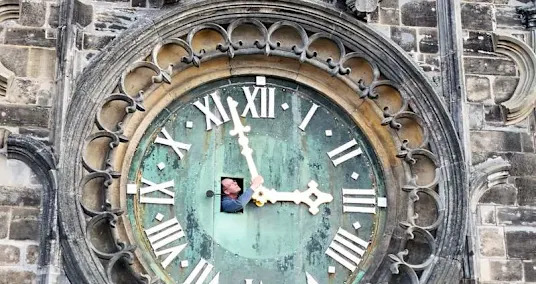
Clocks across the majority of European countries are set to go forward by one hour early on Sunday as the continent moves to daylight saving time, also known as summer time.
Clocks in most European nations including Germany advance by one hour at 2 am (0100 GMT) to 3 am, heralding longer evenings and brighter days.
This means that for the coming months parts of Europe will be on Central European Summer Time (CEST), before moving back to Central European Time (CET) in the autumn, when clocks go back again by an hour on October 25.
The aim of the change is to make better use of daylight in the shorter days of the winter in the northern hemisphere.
The signal for the automatic changeover of the clocks in Germany comes from the Federal Institute of Physics and Metrology (PTB) in the northern city of Braunschweig, also known as Brunswick in English.
The institute's experts ensure that radio-controlled clocks, station clocks and many industrial clocks are supplied with the signal via a long-wave transmitter called DCF77 in Mainflingen near Frankfurt.
LATEST POSTS
- 1
 Germany's far-right AfD tops poll ahead of Merz's conservatives
 - 2Etymological Investigation Disclosed: A Survey of \Dominating New Tongues\ Language Learning Application
- 3Man triggers smoke bomb during failed crypto robbery
- 4'Harry Potter' fans rejoice: HBO releases 1st trailer for new TV series, set to premiere this Christmas
- 5Mali and Canadian miner Barrick agree to resolve tax dispute, ending 2-year standoff



- Eight Muslim nations condemn Israel's 'dangerous' new death penalty law
- Fundamental Home Exercise center Hardware: Amplify Your Exercises
- Tributes pour in for James Ransone, 'The Wire' actor who died at 46
- Mother and Stepson Rescued After Being Swept Over 6 Miles in Paddleboarding Mishap
- Experience Is standing by: History's Most noteworthy Travelers
- Pat Finn, actor from 'The Middle,' dies at 60 after bladder cancer diagnosis
- Energy security rifts widen in Europe
- 'Stranger Things' Season 5: When does Volume 2 come out? And Volume 3? Everything to know about the remaining episodes before the finale.
- How a seabird native to Hawaii has adapted to life in Honolulu's concrete jungle