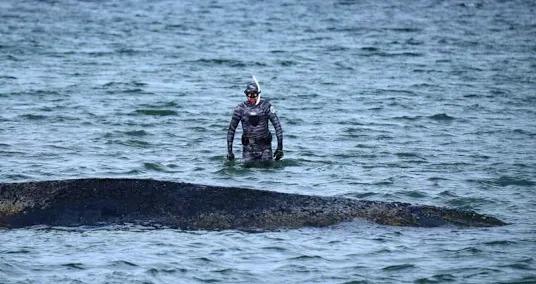
Rescuers on Thursday again attempted and failed to free a humpback whale stranded on Germany's Baltic Sea coast, employing a large suction dredger to remove sand around the animal.
Two excavators dug a trench in an attempt to free the whale, which has been stuck in shallow waters at the Timmendorfer Strand beach since early on Monday, drawing heavy media attention.
The aim of the latest rescue attempt was to approach the 12- to 15-metre-long marine mammal slowly, partly so that it can get used to the sounds, said Sven Partheil-Böhnke, the mayor of Timmendorfer Strand.
The work requires full concentration as rescuers are expected to reach within a centimetre of the animal's head, explained the mayor.
Excavator operator Tim Löhndorf told dpa on Wednesday that the plan was to dig a trench 50 metres long, six metres wide and 1.20 metres deep in front of the whale's head.
Wind and currents would pose particular challenges during the rescue operation, he said.
Before the rescue attempt began, biologist Robert Marc Lehmann approached the stranded animal, which reacted with movement and loud snorting.
The diver's assessment showed that the animal appeared to be in relatively good condition, said Stephanie Gross from the Institute for Terrestrial and Aquatic Wildlife Research (ITAW), adding that the whale seemed motivated.
Efforts to free the huge seaborne mammal continued into the night but were ultimately called off late on Thursday and are set to resume on Friday. By Thursday evening, however, the animal had at least managed to shift its position slightly, a dpa reporter said.
Even if the whale can be successfully freed, it will not yet be out of the woods. As the Baltic Sea is not its natural habitat, it must find its way back to the North Sea and then on to the Atlantic without becoming stranded again.
The Baltic Sea presents a bottleneck, said Jan Herrmann, a vet and whale expert from Wilhelmshaven.
"It has to find the way out again, and it is not entirely certain that the humpback whales' navigation system is designed for that," Herrmann said.
ITAW expert Joseph Schnitzler said the whale would certainly need to be escorted to find its way out.
"And then we'll just have to hope that the animal makes the right decisions, because you can't really guide it," he added.
The humpback whale was discovered on the sandbank on Monday morning. On Tuesday, a rescue attempt with a small suction dredger failed.
Attempts to make waves using police boats to allow the whale to swim free also proved unsuccessful. Even the high tide on Tuesday night was not enough to free the trapped sea mammal.
According to experts, humpback whales can weigh up to around 30 tons and have a life expectancy of up to 90 years. The species is characterized by its long pectoral fins, which reach a third of its body length.

LATEST POSTS
- 1
 Brexit's Effect on New York's Ascent as a Main Monetary Center
 - 2‘Harry Potter and the Philosopher’s Stone’ trailer is raising eyebrows among Potterheads: ‘Where’s the whimsical color?’
- 3These are the Fastest Italian Sports Cars
- 4French high-speed train slams into truck, killing TGV driver
- 5Unfathomable and Entertaining Legal disputes That Surprise everyone





- Pick Your #1 game to observe
- Vote In favor of Your Favored Language Interpretation Administration
- ‘Ukrainian housewives’ and Skyranger delays – German defense poster child Rheinmetall is in hot water
- The Fragrant Small Tree Birds & Pollinators Love With Stunning Flowers In Summer
- Charity 'feels the pinch' of higher energy prices
- Ariana Grande says Eternal Sunshine 2026 tour will be her last for a 'long, long time': 'One last hurrah'
- NASA's Apollo 8 moonshot saved 1968. Could Artemis 2 do the same in 2026?
- ‘Grit’ and relentless perseverance can take a toll on brain health − particularly for people facing social stresses like racism
- Coffee Prices Finish Higher on Brazil Cop Concerns