By Steve Gorman
(Reuters) -A geomagnetic storm on Earth triggered by a large burst of solar radiation has temporarily grounded a Blue Origin rocket carrying twin NASA satellites built to measure space weather on Mars.
Blue Origin says its giant New Glenn rocket stands ready for liftoff on what would be the first major NASA-scale science mission that Jeff Bezos' space venture has ever undertaken for a paying customer. It also would be the company's first launch of any kind since its inaugural New Glenn flight in January.
"However, due to highly elevated solar activity and its potential effects on the EscaPADE spacecraft, NASA is postponing launch until space weather conditions improve," the company said on its website on Wednesday.
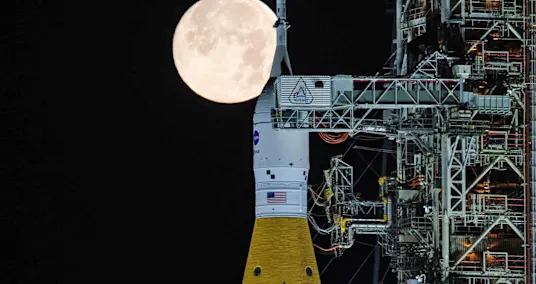
New Glenn, a two-stage, heavy-lift rocket 32 stories tall, had been slated for blastoff on Sunday from the U.S. Space Force Station in Cape Canaveral, Florida, carrying two Mars-bound EscaPADE satellites in its payload bay. But the flight ended up scrubbed for the day because of heavy cloud cover.
The mission had been rescheduled for Wednesday, but Blue Origin indefinitely called off the launch again after alerts for a severe geomagnetic storm were posted by the U.S. Space Weather Prediction Center. The storm was unleashed by a surge in high-energy charged particles spewed into space from large eruptions on the sun's surface called "coronal mass ejections."
The resulting stream of charged-particle radiation, or plasma, was measured on Earth on Wednesday at G-4, or "severe" levels, one step down from the highest stage of G-5 or "extreme." The geomagnetic storm was forecast to persist at severe strength on Thursday.
Geomagnetic storms are known to disrupt radio and satellite communications. They also can increase atmospheric density, creating intense friction or drag on satellites and other spacecraft in low-Earth orbit, as occurred in February 2022 when 40 Starlink satellites newly launched by SpaceX were disabled.
Elevated levels of charged particles from the sun can also more easily escape Earth's protective magnetic field and collide more vigorously with molecules in the atmosphere, heightening the extent of colorful aurora displays visible in the night skies, mostly in polar regions.
The vibrant green and pink displays of Northern Lights, or Aurora Borealis, were reported across unusually large swaths of the United States on Tuesday night as far south as Texas, Florida and Alabama, with another round of higher-latitude appearances forecast for Wednesday.
Ironically, the twin satellites of EscaPADE, short for Escape and Plasma Acceleration and Dynamics Explorers, are intended to study similar phenomena on Mars at the end of a 22-month voyage to the Red Planet.
The two spacecraft, dubbed Blue and Gold, are designed to orbit Mars in tandem to analyze how streams of charged solar particles interact with Mars' relatively weak magnetic field and how that interaction has caused the planet to lose much of its atmosphere over billions of years.
(Reporting by Steve Gorman in Los Angeles; Editing by Tom Hogue)
LATEST POSTS
- 1
 74 suicide warnings and 243 mentions of hanging: What ChatGPT said to a suicidal teen
- 2Eating Brie, Gouda, cheddar may lower dementia risk, new study says
- 3The Solution to Individual budget: Dominating Cash The board
- 4Dozens of hidden star streams found in the outskirts of our Milky Way galaxy
- 5the Wild in Style: The Reduced Portage Mustang's Bold Heritage



- Countdown to Artemis II: What to know about NASA's moon mission
- Eleven Creations And Developments That Steered History
- Investigate Business Mastercard Choices for Better Rewards and Rewards
- Agios Pharma shares jump as US FDA expands approval for its blood disorder drug
- Passover under fire: Israelis balance fatigue with cautious hope after month of war
- Insane Realities That Will Make You Reconsider How you might interpret History
- Hundreds of kilos of protected plant seized by Israel Nature and Parks Authority in Golan
- I decided to become a single mother by choice. I wasn't ready to stop dating.
- Dominating the Art of Composing: Creator Bits of knowledge